

Most professional services delivery challenges don’t announce themselves. They surface slowly through extended timelines, uncomfortable re-planning, and sometimes re-working conversations. As a result, teams stay busy while outcomes remain just out of reach.
This is the environment where the project sprint earns its relevance.
A project sprint creates a deliberate pause in long, complex projects. The goal is not to slow work down, but to make it observable. By fixing the time window and narrowing the focus, a project sprint reveals whether plans hold up against real constraints, such as your initial capacity planning and estimations, dependencies, and client input.
That visibility is the real value of sprint planning. And it’s also why metrics matter, not as a scoreboard, but as signals that help teams and leaders understand whether delivery is converging or quietly spreading sideways.
“Project progress doesn’t give sufficient information on where to improve, while 'done' only tells half the story.” - Dan Radigan, Atlassian
Before getting into the metrics, it’s worth grounding the conversation with a shared understanding of terms.
Sprint Meaning in Project Management: What Does a Project Sprint Solve?
In project management, a sprint is a fixed period of time, typically one to four weeks, during which a team commits to completing a defined set of work.
A project sprint reduces uncertainty by bringing planning closer to reality. Instead of discovering misalignment at a phase gate or client review, teams surface it inside the sprint when adjustments are less costly, and confidence is easier to maintain.
While rooted in agile thinking, effective sprint planning in professional services is less about strict adherence to frameworks and more about creating clearer signals for delivery decisions, earlier in the process.
Organizations that create visibility into expectations and real-time performance can improve operational performance by 30–50%, particularly in speed, predictability, and target achievement. — McKinsey & Company
Is a project sprint just Scrum rebranded?
Project sprints originated in agile and Scrum practices, particularly in software development. Over time, professional services teams have adapted the concept, keeping the short planning horizon and feedback loop, while moving away from rigid roles and formal process requirements that don’t always fit client delivery work.
What changes when sprint planning replaces long-range commitments?
When sprint planning replaces long-range commitments, delivery decisions are more closely aligned with execution. Assumptions are tested sooner, tradeoffs become explicit, and feasibility becomes visible while there’s still room to respond and adjust. The result isn’t perfect plans, but earlier signals. That’s why sprint metrics matter. They show whether the sprint is actually creating clarity or merely compressing work.
How Team Leaders Use Sprint Metrics to Understand Delivery Health
A project sprint only creates value if it clarifies delivery. Without visibility, a sprint simply compresses work into smaller time boxes without improving outcomes.
Sprint metrics exist to answer a practical question: Is the sprint reducing uncertainty, or just redistributing it? Used well, they surface whether plans are holding, where capacity is under pressure, and how work is actually flowing, not how it was expected to flow.
The following metrics focus less on performance and more on signal. Together, they show whether sprint planning is translating into execution, or whether adjustments are already needed.
1. Running Pace: Monitoring Progress Daily
Running pace, typically expressed as a percentage, compares the work that should be completed by a given day in the sprint with the work that has actually been closed.
Its value lies in timing. When progress starts to drift early, the team has options: scope adjustments, sequencing changes, or conversations that would be harder later. When that drift only appears at the end, those options tend to narrow.
Running pace turns the sprint from an “after-the-fact” view into something observable day by day.
Related: See how Forecast PSA enables teams to set and monitor project milestones.
2. Pace: How the Sprint Landed Against the Plan
Pace, measured at the end of the sprint, looks at how much time was spent during the sprint period compared to what was estimated in your project sprint planning.
Over multiple sprints, patterns emerge. Some teams consistently overcommit. Others leave value on the table. Neither is a failure; both are planning signals. A stable pace suggests sprint commitments are aligning with real capacity, while volatility points to assumptions that may need revisiting: scope, sequencing, or available time.
3. Velocity: Trend Data Across Multiple Project Sprints
Velocity averages delivery across completed sprints, smoothing out anomalies and short-term variation.
For delivery leaders and executives, velocity provides a broader sense of momentum. It answers questions about throughput and sustainability that single-sprint metrics can’t.
Where pace helps teams adjust quickly, velocity helps leadership understand direction and the bigger picture.
4. Remaining Capacity: A Reality Check on Delivery Feasibility
Remaining capacity tracks how much time or effort remains before the sprint ends.
Viewed alongside remaining work, it answers a simple but essential question: How is the team progressing, and is delivery still feasible within the sprint as planned?
When capacity declines faster than work, teams often feel the tension before they can articulate it. This metric makes that tension visible, and therefore discussable.
5. Sprint Progress: Completion at a Glance
Sprint progress shows how much of the planned work in a sprint has been completed, based on reported time against the sprint’s forecast.
On its own, this sprint metric is a blunt instrument. Paired with time left and remaining capacity, it becomes more informative, helping teams distinguish between activity and meaningful progress.
This is often the metric that anchors conversations, even when others provide the deeper insight.
“We want to be very transparent about the progress of the projects, and that’s something we can do with the Forecast PSA platform.” - VP of Operations, Nexus Innovations
6. Sprint Forecast: Using History to Inform the Present
A sprint forecast is an estimate of the work that will likely be completed within the sprint, based on the scope of work and available capacity. Unlike initial sprint planning estimates, a forecast adjusts expectations as real performance data becomes available.
In Forecast PSA, sprint forecasts are informed by historical delivery patterns, using AI to understand how similar work has been completed in the past, how roles tend to consume time, and how individual performance varies in practice. Over time, Forecast PSA’s AI-powered engine learns from your patterns to refine expectations and surface more realistic delivery projections. What exactly does it mean for project managers and teams?
- If a team member is always faster than the hours previously added to the task, the AI will show a better forecast.
- If a team member consistently registers more time on tasks than is allocated, the AI will take that into account.
The value isn’t perfect accuracy; it’s credibility. Sprint forecasts grounded in observed behavior tend to hold up better under pressure and give teams and stakeholders a clearer sense of what’s achievable before constraints become critical.

7. Planned vs. Actual: Comparing Assumptions to Reality
Comparing planned time with actual time surfaces the gap between intention and execution.
When actual time exceeds the plan, it often points to hidden complexity, under-scoped work, or interruptions that weren’t visible during sprint planning. When actual time comes in below the plan, it may indicate overestimation, deferred work, or shifts in priority. Neither outcome is inherently good or bad.
These differences aren’t problems to eliminate; they’re insights to accumulate. Over time, they sharpen estimation, reveal systemic friction, and reduce reliance on guesswork in future sprint planning.
“Forecast PSA gave us the ability to look into all the numbers and find out what wasn’t working … and focus on getting our numbers right before we made any more decisions….” — CEO of Grafikr
8. Sprint Burndown: Progress Toward the Sprint Goal
A burndown chart is a visual representation of how the team is progressing during the sprint, showing completed work over time remaining.
Its strength lies in its simplicity. Because it’s easy to interpret at a glance, it works well in regular team check-ins, helping teams see whether progress is tracking close to expectations or beginning to drift. That shared visibility makes it easier to discuss trade-offs early, without framing the conversation around individual performance.
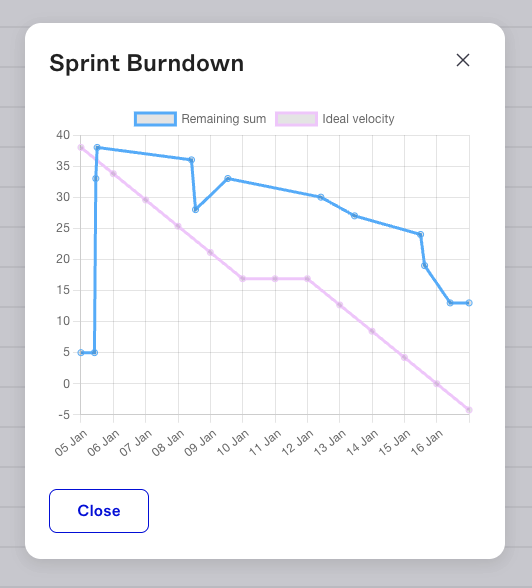
In Forecast PSA, the sprint burndown reflects both planned effort and recorded actual time, allowing teams to see progress in the context of the sprint’s original intent. Rather than treating the burndown as a report to review at the end, it becomes a working reference throughout the sprint.
9. Cumulative Flow: How Work Is Moving, Not Just Finishing
Cumulative flow diagrams show how much work is waiting, in progress, and complete.
These diagrams reveal patterns that completion metrics miss: growing queues, stalled work, or late-stage surges that point back to sprint planning decisions. For teams managing complex dependencies, this view often explains why progress feels uneven.
From Measurement to Meaningful Delivery
Metrics don’t improve delivery on their own. They create shared understanding.
When teams can see how planning assumptions play out inside a project sprint, conversations change. Adjustments happen earlier. Tradeoffs become explicit. Learning carries forward into the next sprint.
Platforms like Forecast PSA support this by bringing sprint planning, capacity, time tracking, and delivery metrics into a single, connected view, reducing the friction between insight and action.
The value isn’t in measuring more. It’s in seeing sooner.
And in professional services, seeing sooner is often what keeps delivery on track.
See what more informed sprint planning looks like.
Explore how Forecast PSA brings planning, capacity, and delivery signals into a single, connected view, so your team can see earlier, adjust sooner, and enter each sprint with greater confidence. Book a personalized demo now.
Sprint Planning FAQs
What is sprint planning?
Sprint planning is the process of deciding what work a team will commit to delivering within a fixed time period, based on current priorities and available capacity. In professional services, effective sprint planning focuses less on predicting perfectly and more on creating clear, short-term commitments that surface risk early and support better delivery decisions.
Why is sprint planning important in professional services?
Sprint planning helps professional services teams reduce uncertainty by aligning scope, capacity, and expectations in short planning cycles. By creating earlier visibility into delivery constraints, teams can adjust before small issues become client-facing problems.
How do you know if project sprint planning is working?
Project sprint planning is working when teams gain earlier visibility into delivery risks and trade-offs, not just when work is completed on time. Consistent sprint metrics, such as pace, remaining capacity, planned versus actual effort, and burndown trends, help teams see whether planning assumptions are holding and where adjustments are needed before issues escalate.
This article was originally published on November 1, 2019, and was updated on January 21, 2026, for accuracy and relevancy.